Sunday, March 27, 2011

EYES

 
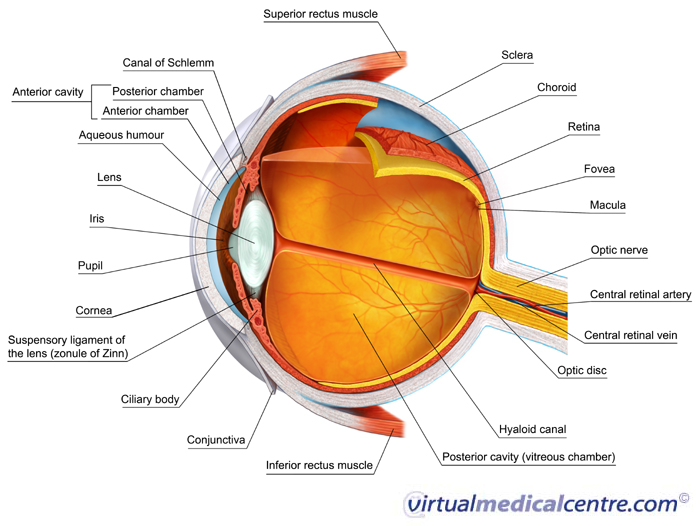
http://www.virtualmedicalcentre.com/uploads/VMC/DiseaseImages/2133_eye_anatomy_label_v2_700.jpg
Zonules: ring of fibrous strands connecting the ciliary body with the crystalline lens of the eye
Cornea: front sixth clear layer in which all light must pass first when it enters the eye
Iris: colored part of the eye; an adjustable diaphragm around an opening called the pupil
Lens: clear, bi-convex structure which changes shape because it is attached to muscles in the ciliary body to fine-tune vision
Ciliary body: muscular area attached to the lends which contracts and relaxes to control the size of the lens for focusing
Optic nerve: conducts the electrical impulses from the light entering the eye to the brain
Choroid: second layer of the eye that contains the blood vessels that supply blood to structures of the eye
Sclera: tough, outermost layer of the eye which maintains the shape of the eye
Retina: innermost layer and light-sensing portion of the eye which contains rod cells (responsible for vision in low light) and cone cells (responsible for color vision and detail)
Macula: center of the retina which contains the fovea centralis (contains only cones and is responsible for seeing fine detail clearly
Myopia vs. hyperopia
Near-sightedness vs. far-sightedness
Myopia is a refractive defect of the eye in which light produces an image in front of the retina which translates to you are better at seeing objects close up than far away. Hyperopia is literally the exact opposite. Thus, the image is produced behind the retina which means that you can see objects better far way than close up. Myopia usually occurs with an eyeball that is longer or a cornea that is steeper than normal. Hyperopia usually occurs with an eyeball is shorter or the cornea has too little curvature.
LASIK surgery:
LASIK surgery is performed with a laser programmed to remove a defined amount of tissue from the cornea. The doctor will cut a flap on the top layer of the cornea which allows access to the deeper layers of the eye. They layer is used again to flatten certain tissue or to make the tissue steeper, depending on the needs of the patient. Finally, the flap is folded back into place and will heal on its own. This procedure corrects vision because it makes up for the discrepancies of the eye making sure the image will be focused on the retina, not ahead or behind it.

SLEEP

Neurotransmitters and the circadian clock:
Neurotransmitters are chemical messengers between nerve cells and allow communication between the brain and other organs. Sleep is influenced by neurotransmitters and hormones. There are two types of neurotransmitters: excitatory (epinephrine, norepinephrine, dopamine, glutamate, PEA, histamine) and inhibitory (GABA and serotonin). They are involved in all aspects of sleep (waking, transitions, etc.). An imbalance in one or more of these chemical messengers can lead to sleep difficulty. The sleep cycle stems from the interaction between the circadian clock and a separate sleep-wake homeostatic process. The circadian rhythm relates to a periodicity of 24 hours. It is linked to fluctuations of behavioral and physiological functions such as sleep and awaking. It is our internal sleep regulation process.  We use light as cues as well.
REM vs. nREM sleep:
Sleep is prompted by natural cycles of activity in the brain and consists of two basic states: rapid eye movement (REM) sleep and non-rapid eye movement (nREM) sleep which consists of four stages. During sleep, the body cycles between nREM and REM sleep. Usually, we begin the sleep cycle with nREM sleep followed by a short period of REM sleep. Dreams occur only in the REM stages of sleep. During nREM sleep, the body repairs and regenerates tissues, builds bone and muscle, and appears to strengthen the immune system.
Sleep disorders:
Insomnia: a disorder that can make it hard to fall asleep, hard to stay asleep, or both; insomniacs may lie awake for hours before falling asleep; insomniacs may wake up too early and be unable to drift off again, or may wake up repeatedly throughout the night
Sleep apnea: a disorder characterized by abnormal pauses in breathing; people with sleep apnea may stop breathing many times while they sleep and the breathing pauses last several seconds which trigger a switch from deep sleep to light sleep
Restless leg syndrome: a sleep disorder characterized by discomfort which induces the urge to move the legs at rest which makes it difficult to fall asleep; some experience twitching motions during sleep that cause brief awakenings
Narcolepsy: extreme sleepiness during the day; people find it hard to function without naps despite spending enough time in bed at night; narcoleptics enter REM sleep almost immediately without the nREM sleep stages which normally lead up to dream sleep.
Effects from a lack of sleep: fatigue, lethargy, lack of motivation, moodiness, irritability, reduced creativity and problem-solving skills, inability to cope with stress, reduced immunity (frequent colds and infections), concentration and memory problems, weight gain, impaired motors skills and increased risk of accidents, difficulty making decisions, increased health risks and problems
How much sleep should I get?
Average Sleep Needs
Age
Hours
0-2 months
12-18
3 months-1 year
14=15
1-3 years
12-14
3-5 years
11-13
5-12 years
10-11
12-18 years
8.5-10
18+ years
7.5-9


OVARIAN AND UTERINE CYCLES

Ovarian cycle: cycle where an oocyte will mature, erupt from an ovary, and travel down the oviduct to the uterus
Uterine cycle: cycle where the lining of the uterus grows and prepares for an embryo to implant, but if an oocyte is not fertilized then menstruation occurs
GnRH: gonadotropin releasing hormone stored in the hypothalamus triggers the release of FSH and LH
LH: luteinizing hormone produced by an implanted embryo; when released it causes the follicle to release the egg (ovulation); triggers remaining follicle cells to differentiate into the corpus luteum (which secretes estrogen and progesterone)
FSH: follicle-stimulating hormone produced in the pituitary gland; stimulates ovarian follicles to grow which begins the secretion of estrogen
Estrogen: increased levels of estrogen serve as a source of positive and negative feedback to regulate the levels of FSH and LH
Progesterone: secretion from a follicle that released an egg; responsible for the thickening of the endometrium and preparing to support embryonic development
hCG: human chorionic hormone is secreted once the egg has been fertilized and is detected in pregnancy tests
Positive Feedback Loops: An increase in the hormone levels after the release of an egg into the ovary because more hormones are needed to aid in the proper development of the zygote to a fetus (when fertilized)
Negative Feedback Loops: a decrease in the hormone levels within the body which decreases GnRH levels
Menstruation vs. Pregnancy: hormone levels are much lower during menstruation than during pregnancy which is an easy source for differentiating between the two processes
Fetal development
First trimester: zygote is turning into a fetus; embryo is made of three layers; organs in the fetus are in their first stages
            Second trimester: fetus continues to grow and develop; brain and lungs form
            Third trimester: fetus is growing the most rapidly

IMMUNE SYSTEM

The ABC's about your immune system...
Pathogens (Germs): an infectious agent
            Examples: virus, bacteria, fungus, prion
Macrophage: Type of white blood cell that attacks foreign invaders in the body; help destroy bacteria, tumors, etc. via phagocytosis
Antigen: Any foreign substance that can enter the body
Helper T cell: Type of white blood cell that recognizes antigens releasing cytokines that active B+ killer T cells
B cell: Lymphocytes that will release antibodies to fight off antigens; important role in immune system responses
Antibody: Proteins that bind to an antigen and neutralize it
Killer cell: Destroy antigens that are discovered by antibodies
Cytoxic T cell: Type of T-cell which kills cells that are infected with viruses and other pathogens
Memory cell: Immune cells with a long lifespan which remembers attacks by certain antigens; when those antigens return, memory cells trigger a quick immune response before the body experiences the symptoms  
Innate vs. adaptive vs. passive immunity
Innate immunity is a type of general protection which everyone is born with. It includes the external barriers of the body such as the skin and mucous membranes (lining of the nose, throat, gastrointestinal tract, etc.). These are the first lines of defense in preventing antigens from entering the body. It this is broken, the membranes attempt to heal quickly and specialize immune cells attack invading germs. The next type of protection is adaptive or active immunity. This develops throughout our life and involves the lymphocytes. As we are exposed to diseases or immunized against diseases through vaccination, adaptive immunity develops. Finally passive immunity is the last type of protection. It is a borrowed immunity from another source and only lasts for a short time
Immune Disorders
DiGeorge syndrome (thymic dysplasia): a birth defect and a primary T-lymphocyte disease in which children are born without a thymus gland (where T lymphocytes mature)
Chediak-Higashi syndrome (chronic granulomatous disease): the inability of the neutrophils (a type of white blood cells) to function normally as phagocytes (cells that digest foreign organisms)

Sunday, March 20, 2011

EXERCISE PHYSIOLOGY

An exercise physiologist studies the acute responses and chronic adaptations of physical exercise conditions. Specifically, they focus on the effect of exercise on pathology (study and diagnosis of disease) and the mechanisms by which exercise can reduce disease progression. When working with athletes, the monitor and assess cardiovascular and metabolic effects and mechanisms of exercise, replenishment of fluids during physical activity, and exercise for cardiac and musculoskeletal rehabilitation.
Common terms:
Aerobic respiration: Requires oxygen to generate energy in the form of ATP; occurs in fives steps (glycolysis, oxidation of pyruvate to Acetyl Coenzyme A, Krebs cycle, electron transport chain, and oxidative phosphorylation)
Anaerobic respiration: A form of respiration without the use of oxygen
ATP
: Adenosine Triphosphate transports chemical energy within cells; it is produced via cellular respiration and is known as the energy currency of cells
Carbohydrates: Main fuel source for high intensity exercise and main fuel source for muscle contractions
CP: Creatine Phosphate is a molecule that serves as a reserve of high-energy phosphates in the skeletal muscle and brain; it can anaerobically supply a phosphate grout to ADP in order to form ATP during the first 2-7 seconds following an intense muscular effort
Fats: Main fuel source for long duration, low to moderate intensity exercise and help access stored carbohydrates during high intensity exercise
Glycolysis
: The first stage of both aerobic and anaerobic respiration; glucose is converted into a 3 carbon sugar (pyruvate) in ten reduction/oxidation reactions; energy released is used to for ATP and NADH
Lactic acid: A chemical compound playing a significant role in many biochemical processes; byproduct of anaerobic respiration
Protein: Biochemical compound that is a sequence of amino acids that are the building blocks of the body; proteins repair and rebuild muscle that is broken down during exercise and to help optimize carbohydrate storage in the form of glycogen
VO2 max: The maximum capacity of a person’s body to transport and use oxygen during periods of exercise; reflects physical fitness of a person

Energy Pathways
The body cannot easily store ATP, so the body needs to continually for ATP during exercise through aerobic or anaerobic respirtaiton.
1.      ATP-CP: the phosphate system; the combination of ADP and CP which are both stored in muscles create ATP, but it only lasts about 2-3 seconds and the re-synthesis of ATP from CP will continue unto CP storage are depleted
2.      Anaerobic Metabolism: glycolysis and lactic acid production; production of ATP without oxygen once the CP reserves are depleted; it makes energy for a short amount of time during high intensity activity or until lactic acid build-up reaches a threshold with muscle pain and fatigue
3.      Aerobic Metabolism: endurance exercise energy production; oxygen from the Krebs cycle and the electron transport chain manufacture ATP from glucose; it is the prime energy source during endurance activities, but it is slower than anaerobic enrgy because it relies on the circulatory system to transport oxygen to muscle cells to generate ATP

Saturday, March 19, 2011

AGING

Aging is inevitable. It happens to everyone and there is no way to around it. We may try to use cosmetic serums to deceive society, but aging is a natural, physiological process that everyone and every living organism endures over time (time lengths vary immensely). Unfortunately, both genetics and lifestyle are to blame for the process of aging.
Some basic factors:
HDL: Cholesterol is generally seen as a harmful food component, but, in reality, it is an essential nutrient. The key factor is which cholesterol is consumed and the amount of cholesterol consumed. High-density lipoprotein (HDL) is known as “good cholesterol” because it is able to remove cholesterol from arteries and transport that cholesterol to the liver for excretion or re-utilization. On the other hand, low-density lipoprotein (LDL) is known as “bad cholesterol” because high levels of LDL promote heart problems and cardiovascular disease. Thus, people with higher levels of HDL in their body have a higher chance of living longer because they have a decreased risk of cardiovascular issues.
Aging and sirtuins: Sirtuins are a class of proteins that possess either histone deacetylase or monoribosyltransferase which influence aging and regulation (transcription, apoptosis, stress resistance, etc.). Harvard’s David Sinclair works closely with siruins and their effect of longevity on yeast and other organisms.
Telomere: Telomeres is a region of repetitive DNA at the end of a chromosome which protects the ends of chromosomes from deterioration. Aging occurs on a cellular level. Eventually cells lose the ability to divide and repair itself. The loss of this ability to divide is known as cellular senescence. As we age, telomeres decompose or decay. Thus, the cell continues to divide, but the telomeres shorten. Sooner or later, the telomeres become so short that essential parts of DNA can be damaged in the replication process. Leonard Hayflick found that a human cell replicates 50 times before the telomeres become too short. If the telomeres are two short, the cell will stop replicating and dividing altogether.
Pharmaceutical companies: Resveratol is a possible sirtunis. It is believed to assist in the repair of DNA and regulate genes that undergo altered expression with age. Scientists speculate that this natural phenol could extend lifespan. This hypothesis is still in dispute and in the experimentation phases, though. In 2003, Howitz and Sinclair report in the journal Nature that resveratol significantly extends the lifespan of yeast (Saccharomyces cerevisiae). They also found that it prolong the lifespan of worms (Caenorhabditis elegans) and fruit flies (Drosophila melanogaster). Pharmaceutical companies are working endless hours with this natural phenol to find a product that can conceivably reverse the effects of aging.
Genetics are not the only component of aging. Lifestyle decisions are also to blame when it comes to aging. Exercise, eating habits, stress levels, hygiene, personal health, and drug abuse can all impact the lifespan of humans. A healthy diet and exercise have influenced the increased life expectancy rate throughout the world in the past century. A lack of exercise increase the risk of cardiovascular disease and type II diabetes. There has also been a relationship found between telomere length and smoking. The habit of smoking decreases the length of telomeres faster than their natural rate of decay. These are just a few negative lifestyle habits that decrease an individual’s life span.
References
Leonard Hayflick Proposes The Cellular Theory Of Aging Based On The Limited Replicative Lifespan Of Primary Human Cells. (n.d.). Science of Aging. Retrieved March 19, 2011, from http://science-of-aging.healthaliciousness.com/timelines/hayflick-cells-limited-lifespan.php
Sedentary Lifestyles Associated With Accelerated Aging Process. (n.d.). Science Daily: News & Articles in Science, Health, Environment & Technology. Retrieved March 19, 2011, from http://www.sciencedaily.com/releases/2008/01/080128165734.htm
Your Kids Could Reach 100 - Health Checkup: How to Live 100 Years - TIME. (n.d.). Breaking News, Analysis, Politics, Blogs, News Photos, Video, Tech Reviews - TIME.com. Retrieved March 19, 2011, from http://www.time.com/time/specials/packages/article/0,28804,1963392_1963367,00.html

Saturday, March 12, 2011

STRESS

Stress is extremely common. Everyone experiences it at one point or another. By definition, stress is a physical and emotional reaction that everyone experiences as he or she encounters changes in life. These reactions can have positive (when it makes us deal constructively with daily problems and meet the challenges) or negative effects (when it becomes continues which can lead to depression and heart disease).
Symptoms of stress include increased heart rate, tense muscles, increased blood pressure, fear, confusion, anger, and sweating. These physical and emotional reactions may help us by focusing our concentration and other bodily functions to prepare for a challenge. Our ancestors experienced these symptoms when faced with a wild animal in front of them, but nowadays stress is not manifested in the same ways.
In my life stress comes in all different shapes and sizes. School is a constant source of stress. A full schedule, plus extracurricular activities becomes overwhelming at times. Also, uncertainty about my future and the major changes that lie ahead (college) has been a more current stressor.
Relationships, schoolwork, and personal responsibilities can be both positive and/or negative stressors. After meeting a challenge, the body relaxes as the heart rate, muscle tension, and blood pressure return to normal. This gives the body a chance to recover physically and for the person to feel emotionally rewarded for overcoming the challenge.  
Studies have shown that certain symptoms such as sweat and an increased heart rate is an advantage for acute stress or good stress. However, when physical and emotional stress reactions are non-stopping or perceived as non-stopping, the body never gets a chance to relax, knotted stomach constant tense muscles. This is known as chronic stress or bad stress.
Some risks associated with chronic stress include high blood pressure. This can lead to heart problems and even heart attacks. Migraine headaches, back pain, and ulcers are also frequently associated with stress. The immune system may also be weakened or compromised which makes the individual more susceptible to illness.
Sadly, many individuals with chronic stress may try to relieve chronic stress with illegal drugs, smoking, or alcohol. These stimulants may seem to reduce stress but the feeling will only last a short while and the person is likely to become addicted.
My Survival Guide to Stress
-a stressor is situation that causes stress
-it is necessary and imperative to identify what causes stress in order to try to control it
-common symptoms: headaches, tense muscles, shaky hands, fatigue, insomnia, heartburn
-emotions: nervous, fearful, confused, worried, irritable, hostile, inability to concentrate (these changes in behavior may cause one to snap at others, have accidents, and/or compulsively tap fingers)
-Preventing stress
1.      Avoid controllable stressors
2.      Plan major lifestyle changes: avoid taking on too much at one time
3.      Realize your limits: learn to say NO to new responsibilities you’re not sure you can fulfill
4.      Prioritize: don’t rush, do things one at a time and well
5.      Improve communication
6.      Share your thoughts
7.      Develop a positive attitude
8.      Reward yourself
9.      Exercise
10.  Eat and sleep well: can help develop a healthier lifestyle that is conducive to less stress
-Managing Stress
1.      Plan by visualizing expected events
2.      Think positively: put things into perspective
3.      Imagine potential negative big events: have a back-up plan in case things go differently than expected
4.      Relax with deep breathing
5.      Relax by clearing your mind
6.      Relax your muscles
7.      Relax with stretching and exercise
8.      Relax with massage therapy
9.      Ask for help
10.   Find professional help if needed